
Randolph's Current Owner Record Card
The assessor's search instructions walk through the fields behind each GIS card. The card names the current assessment-roll owner. Extra parcel context keeps similar names and addresses apart.
| Owner name | One or more names currently associated with the assessment card |
|---|---|
| Owner address | Destination associated with the owner; not necessarily the property |
| Parcel address | The situs or physical location used for the property |
| Transfer date | Date the real estate transferred into the displayed owner's name |
| Parcel context | Taxing unit, township, section/plat, routing number and partial legal description |
| Card context | Values, acreage, appraisal date, property class, neighborhood and sketch |
The card settles ownership questions only partly. It offers no conclusion about occupancy and no complete statement of title. Match the parcel key and the physical location. Then match a fragment of the legal description before treating the displayed owner as the answer.
Treat the rest of the card as a cross-check. Deeded acreage, property class, and neighborhood code help. So do section or plat references, land and improvement values, and the appraisal date. Dwelling details and the structure sketch separate two look-alike addresses. A right name on the wrong outline is still the wrong answer. Save the full card before moving to the deed index. Multi-parcel sites and corner addresses often return more than one candidate.
The official field inventory for the property card shows exactly what the assessor publishes. It names every field.
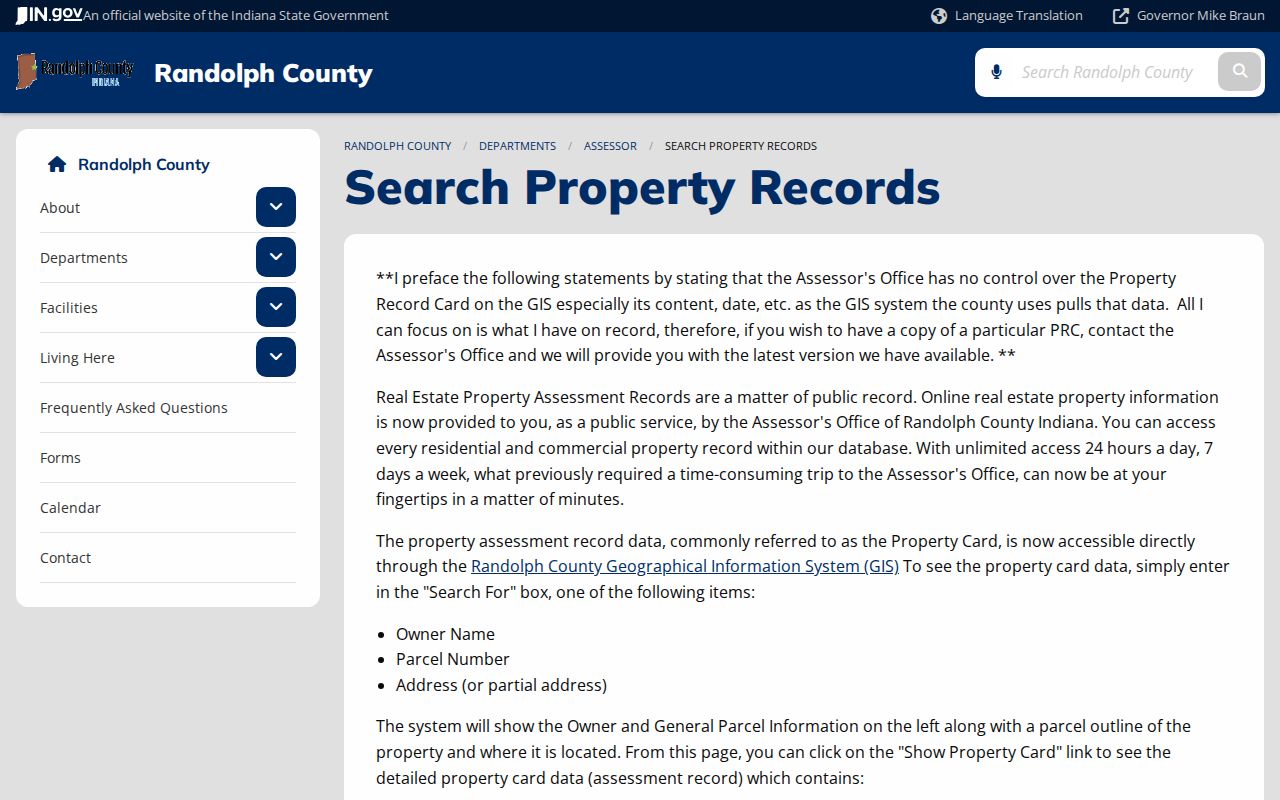
The pairing is deliberate. Owner name and transfer date sit beside parcel geography because current-owner verification depends on a coherent record, not a name copied out of context.
How Current Is Randolph's Owner Field?
Randolph County assessment dates to January 1. Buy after that date and the year's tax bill may still carry the seller's name. The Treasurer expects the new name the following year. The county publishes no standard lag figure. Elapsed time alone never proves the web result current.
The Assessor notes that GIS pulls its data from the card. The office does not control that content or its date. A stale-looking card deserves a follow-up. Request the office's latest property record card directly. Keep the online display date, the transfer date, and the newest deed recording date together for comparison.
Document a January 1 mismatch instead of guessing it away. Record the closing date if you know it independently. Add the deed's recording date, the card's transfer date, and the tax year on the bill. Those dates describe different administrative events. A bill can properly keep the prior name while a later deed already names the new grantee. No fixed waiting period guarantees GIS has caught up.
Recent-sale gap. A tax-roll name can trail a closing. For the current owner, compare the latest office card with the newest recorded deed for the same land.
Owner Mailing Address Is Not Randolph Situs
The situs is where the land actually sits. GIS, permits, and address searching all rely on it. The mailing address is simply where notices go. It might be a second residence, an entity office, a trust address, or an outdated destination awaiting correction. The Treasurer accepts mailing-address updates. The field still never proves occupancy.
Legal description is a third language of location. Lot and addition, section, township, range, bearings, distances, and easement references all name the same Randolph County land differently. Carry the parcel key and partial legal description into the deed check. The Recorder indexes conveyances by party and legal identity, not by searchable street address.
A mailing address may belong to an out-of-county owner, a business office, a trustee, or a representative. It can stay fixed while the situs formatting changes. Equal addresses prove no occupancy. A different one disqualifies no owner. The parcel key and land description identify the real estate; the mailing field only routes correspondence for the roll.
Note: A city name or ZIP helps locate the parcel, but the township and legal description establish its identity in Randolph County's records.
Confirm Randolph County's Current Owner
Compare the assessment roll with the newest recorded instrument.
- Search the address in Randolph Web GIS, choose the correct outline and open the property card.
- Record the exact owner styling, transfer date, parcel key and legal-description fragment.
- Use the DoxPop recorded-document search to locate the newest matching conveyance and compare its grantee and land.
- Request the latest PRC or deed copy at the office if the web records disagree, are inaccessible or omit the needed image.
- Owner of record
- The party currently associated with the property on the public assessment roll.
- Assessment roll
- The annual tax-assessment record, dated January 1 in Randolph County.
- Recording lag
- The interval in which a recent conveyance may be recorded but another display has not yet updated.
- Grantee
- The recipient named in the conveyance; compare that name to the current card.
The Newest Randolph Deed Wins a Timing Conflict
The Randolph County Recorder holds permanent instruments dating back to 1820. DoxPop's online index starts in 1993. Images begin in January 1998. The county describes previews from mid-2003, and the partner table gives the image start, so confirm completeness with the Recorder rather than trusting either cutoff.
| Latest-deed item | Current-owner check |
|---|---|
| Grantee | Does it match the card's owner styling? |
| Recorded date | Is it later than the card transfer or older bill context? |
| Document type | Is this actually a conveyance rather than a lien or release? |
| Book/page or instrument number | Can the official image or copy be retrieved? |
| Legal description | Does it describe the same parcel, lot or tract? |
Self-service searching happens on the Recorder's public terminals. Recorder staff will not run a title search for you. Copies run $1 per page. Certification adds $5 on top of the page charges.
Don't treat the newest grantee as the current Randolph County owner just yet. Confirm the entry is actually a conveyance. Plenty of instruments outrank the deed by date. A mortgage, lien, release, affidavit, power of attorney or fixture filing can all postdate the deed. It transfers nothing. Match the document type. Match the legal description and the party roles too. Then pull the complete image whenever the index wording is abbreviated. Maybe DoxPop lacks the image. Maybe the web result clashes with the office PRC. Then take the instrument number to a public terminal or request that exact copy.
Verify a Randolph Entity or Trust Owner
Spell an LLC, trust or estate name exactly as recorded. Stray punctuation, abbreviations and representative capacity all affect name results. Small differences break a search. Indiana INBiz lets you cross-check a business's legal name, ID, filing, type, status and registered agent. Treat the agent as a contact, not the owner. Trusts need careful trustee styling on the grantee line. An estate may call for the latest deed plus Randolph Clerk probate material. These sources explain a name. But they never displace the newest matching recorded conveyance.
When Randolph's Web Card Looks Old
Ask the Assessor for the freshest PRC. Supply the full key, situs and owner spelling. The Auditor processes deed transfers and keeps the tax list. The Recorder maintains the conveyance itself. Laying those specific records side by side usually pinpoints the cause. The gap may be ordinary annual timing. It could also be a GIS refresh issue or a mistaken parcel selection. Indiana APRA covers requests for identifiable existing records. An electronic request should draw acknowledgement within seven calendar days. Production takes a reasonable time. Ask for a specific card rather than an ownership ruling.
Use Randolph Owner Records Lawfully
The owner mailing address is the public record's most relevant route for property correspondence. Its presence waives no privacy. Nor does it invite unwanted personal contact. Indiana's Address Confidentiality Program supplies eligible survivors with a substitute address for certain government services, so never try to defeat that protection or infer a residence from other fields.
Use the record for the property question. A Randolph current-owner lookup is not permission to stalk, harass, intimidate or harm a person.
Serious title questions call for the actual instrument. Bring in professional help too. The property record card and the latest deed form a disciplined verification pair, not a guarantee against every unrecorded or competing interest.