
Inside Randolph Recorded Deeds
The Recorder keeps Randolph County land instruments permanently at the courthouse in Winchester. Each recorded instrument names the parties, describes the land, and gives public notice of the transfer presented for recording. Read it alongside later transfers. Releases, plats, liens, and court orders matter too. No single document settles every title question by itself.
| Recorded item | Role in the land trail | What to check next |
|---|---|---|
| Deed | Records a transfer by named grantor to grantee | Legal description and later instruments |
| Mortgage | Records a secured interest rather than ownership | Release or satisfaction |
| Affidavit or power of attorney | Explains authority or a fact affecting a transaction | Underlying deed and related probate file |
| Plat or survey | Shows recorded lots, additions, or survey material | Deed calls, easements, and vacations |
| Lien or fixture filing | Places a claim or notice in the public file | Release, satisfaction, or later court action |
The Recorder's index covers a wide range. Transfers, mortgages, federal and mechanics liens, leases, subdivision plats, surveys, affidavits, powers of attorney, and UCC fixture filings all appear there. The index entry locates the instrument. The recorded image carries the terms that fix what interest was conveyed or preserved.
Randolph Deeds Begin in 1820
Recorded land documents in Randolph County date to 1820. The county was created in 1818. Winchester soon became the county seat. The office scans, indexes, and microfilms each instrument for public notice and long-term preservation. That continuity matters, because modern search screens cover only part of the collection. Start with the Randolph County Recorder page for hours, record groups, terminal access, and copies.
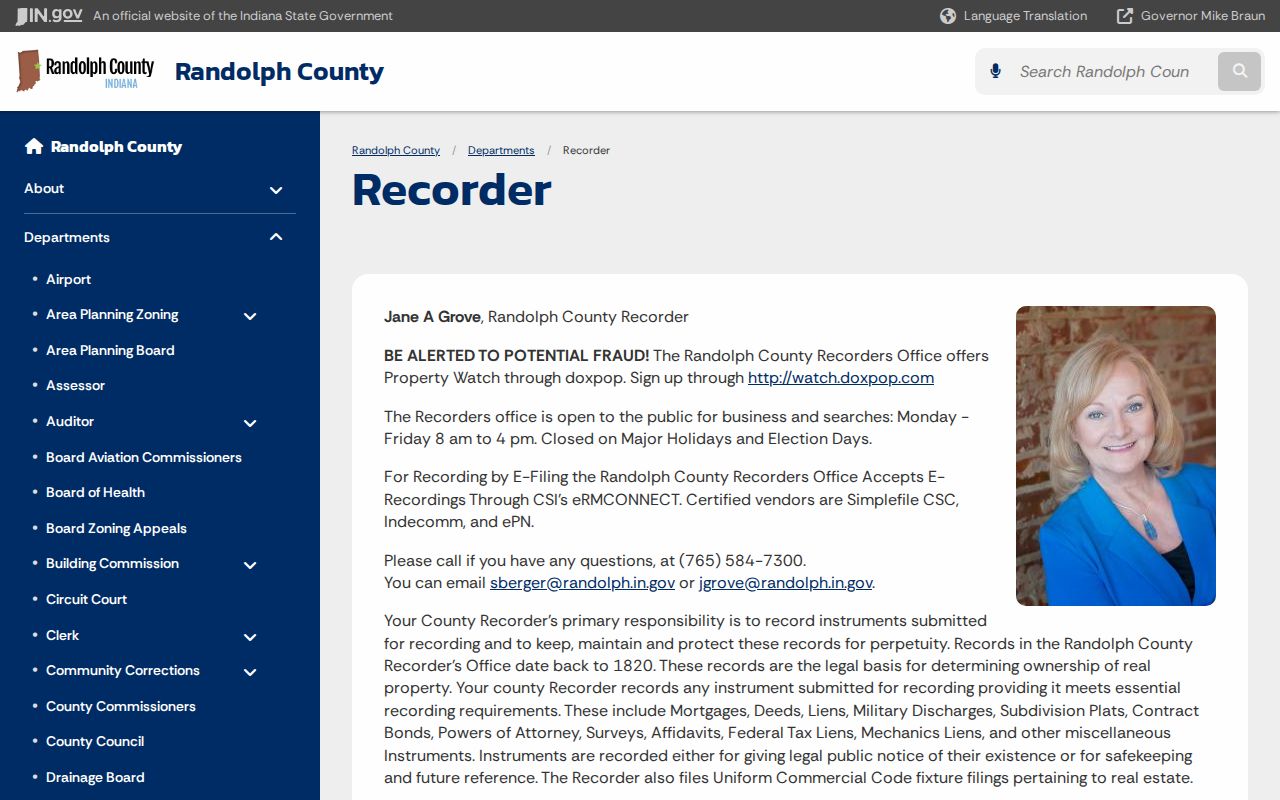
The Recorder page routes a request, but the deed or certified copy remains the record worth examining.
DoxPop's Randolph Deed Window
DoxPop's county table carries Randolph index data from January 1993. The county itself describes searchable documents from mid-1993. Image coverage is murkier. DoxPop lists images from January 1998, while the county FAQ says previews begin around mid-2003. Keep the discrepancy in view when planning a search.
| Search control | How it helps | Known limit |
|---|---|---|
| Party name | Find grantor or grantee entries | Spelling and entity format matter |
| Recorded date | Narrow a transfer period | Use the recording date, not just closing date |
| Document type | Separate deeds from liens or plats | Exact options require the live interface |
| Legal-description text | Find lot, addition, or section clues | Old OCR can miss faint text |
Detailed results and images can require an account or payment. DoxPop also rejects searches topping 500 recorded documents, so narrow a common surname by date or document type.
Follow Randolph Grantor and Grantee
A grantor-grantee index organizes both sides of every instrument. To build a chain, begin with the latest confirmed deed rather than the name on a tax bill, matching the legal description, parcel clues, and recording date at every step. Verify each link before moving back in time.
- Find the current owner's acquisition deed with that owner as grantee.
- Read the grantor, complete legal description, and recording reference.
- Search that grantor as an earlier grantee and verify the same land.
- Repeat until the online index ends, then shift to courthouse books or microfilm.
- Grantor
- The party shown as transferring an interest.
- Grantee
- The party shown as receiving that interest.
- Chain of title
- The linked sequence of instruments affecting the same land.
- Recording reference
- The instrument number or book and page used to retrieve a record.
Legal Descriptions Guide Randolph Deeds
A street address finds a parcel, but the legal description links transfers across time. Randolph descriptions vary widely. Some use an addition and lot, a township section, an abbreviated rural call like “Pt S Sw,” or metes-and-bounds language. Copy the text exactly as written. Spelling and punctuation variants matter.
Historic geography can unlock a stalled search. Winchester instruments may cite Mumma's or Colgrove additions and former railroad rights-of-way. Union City's 2024 planning minutes documented old Governor Isaac Gray, Doty's Second, Maple Heights First, and Jackson Park plats overlapping a newer layout. Treat those names as search terms. They point toward plats, vacations, and recorded transfers, not modern neighborhood boundaries.
Older Randolph Deed Books
A blank pre-1993 DoxPop result says little. Visit the public terminal. The Recorder can point to the correct deed book, plat, survey, or index reference. The Indiana State Library's Randolph guide adds historic plat books and county maps, and the Historical Society helps connect local names with old addresses.
FamilySearch catalogs Randolph probate records from 1819 through 1921 on fourteen microfilm reels. A general index runs 1831 through 1931. Probate explains estate transfers that never show up as a simple sale between two individuals. It cannot replace the deed. But it names the representative. It also gives the court authority needed to resume the chain.
Protect Randolph Deed Names
Randolph County links to DoxPop Property Watch as a fraud-alert signup route. The exact signup fields and notification schedule stay unclear. Confirm the current terms during enrollment. The Property Watch service sends notices. It does not block recording and does not prove a filing is fraudulent.
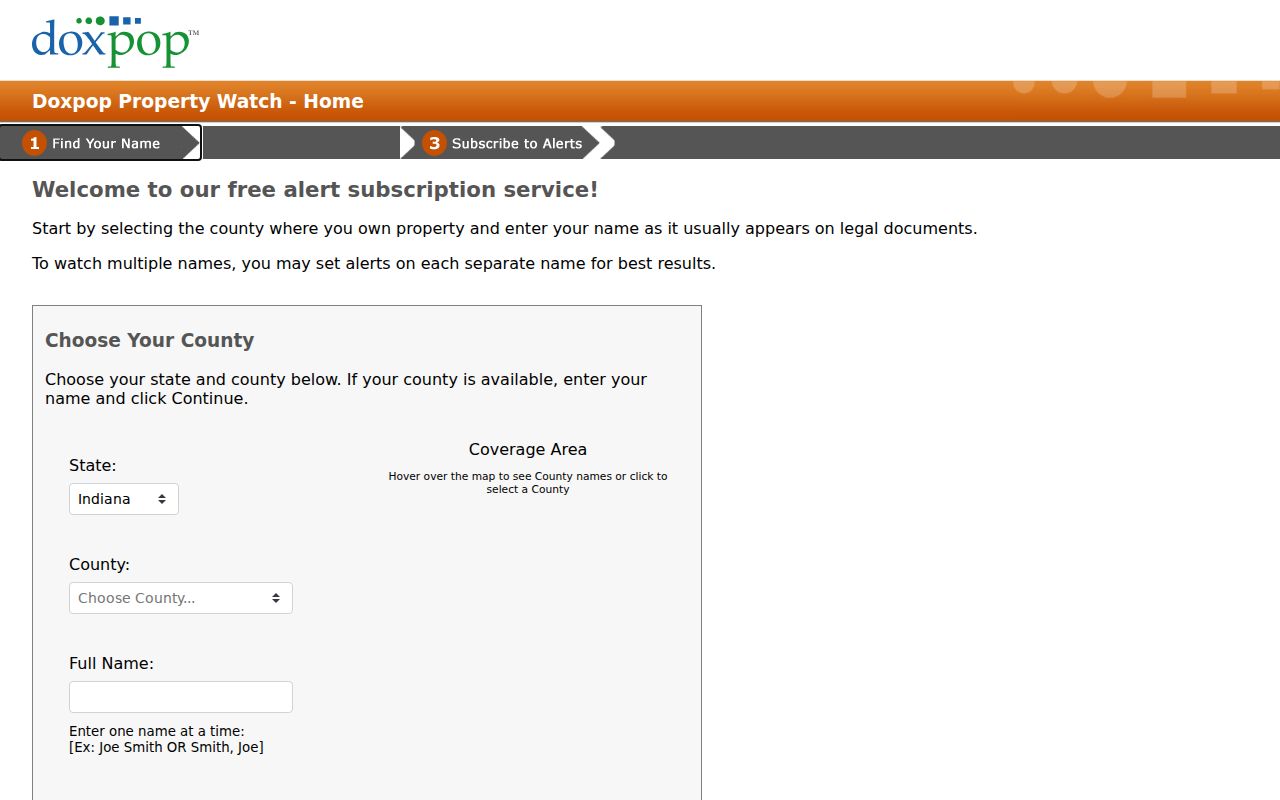
A useful alert should prompt review of the indexed instrument. Contact the Recorder through official county details.
Randolph Plats Change the Trail
Sometimes the land changed, not the owner. A parcel split, plat vacation, lot combination, or overlapping addition can create a new key or legal description. Since July 1, 2017, any document containing a parcel split must go to Randolph Area Planning for certification before recording. That rule builds a cross-office trail. Planning forms, Auditor transfer data, GIS keys, and the deed all connect.
Search each interest separately. A deed may convey the fee. A plat may shape lots. An easement may burden part of the tract, and a later release may end an interest. One deed-record result rarely tells the full story.
Search Randolph Liens and Releases
Liens live in the same Recorder books as deeds and mortgages. A Randolph County property search for claims should cover several record families. Those include mechanics liens, federal tax liens, leases, affidavits, contract bonds, and UCC fixture filings. Each family of records answers a different question. One filing shows a claim. A later release or satisfaction shows it was cleared. Never stop at the first lien hit in the deed records. Always check for later entries under the same party and land description.
Search controls matter here. Use current and former owner names as one lever. Document type, recording date, and legal-description text work as separate levers too. An entity can appear with punctuation, abbreviations, or a trust label. So try both the exact indexed style and sensible variants. A release may be indexed under a lender, claimant, borrower, or owner whose name differs from the original filing. It may instead appear under a document reference. Match instrument numbers and the affected land rather than trusting a name match alone.
Staff cannot run a lien or title search for you. The public terminal therefore does the heavy lifting for broad or older work. Keep a chronological table recording each filing, the parties, and the legal-description match. Also note any later release. Treat that table as a research aid, not a legal opinion on priority or enforceability.
Bridge Randolph Probate Transfers
Not every Randolph County deed comes from a plain sale. An ownership chain can run through an estate, a trust, a life estate, a personal representative, or a court order. Search the grantee too. Check "Estate of" entries and the names of decedents, trustees, and representatives. The public court record may be open. When it is, take the related probate matter to the Randolph County Circuit Court Clerk or Indiana MyCase.
Probate files answer questions the deed books do not. They show who held authority to act. They name heirs and devisees, and often explain a gap between assessment names on the tax roll. Still, the recorded instrument controls the land-record step. A life-estate or remainder clause can split present and future interests in ways the owner-of-record label never shows. Read the complete deed rather than trusting a single displayed name.
Early transfers reward patience. Pair courthouse deed books with the State Library guide and the FamilySearch probate collection. Log the volume, page, reel, index name, date range, and spelling each source used. Surnames drift and place names change. The legal description is the stable bridge back to the same Randolph County parcel every time.
Order a Randolph Deed Copy
The Recorder sits in Room 101 of the courthouse. The courthouse is at 100 South Main Street in Winchester, Indiana. Hours run Monday through Friday, 8 a.m. to 4 p.m. Major holidays and election days close the office. Public terminals let visitors run their own deed records searches. Staff may not conduct a lien or title search or give legal advice.
Fees are simple at the counter. Standard pages up to 11 by 17 inches cost $1 each. Oversized pages run $5 each. Certification adds $5 on top of the page charges. DoxPop image checkout varies by account and price tier. Compare the live amount against the Recorder's schedule before you buy. Whenever possible, bring the party names, recording date, document number or book and page, and the legal description for the parcel.
Recorded is not guaranteed title. The public index shows instruments accepted for recording. It does not resolve every defect, priority dispute, unrecorded claim, or boundary issue.
An Indiana Access to Public Records Act request can pinpoint an existing deed. It can also pull a related file. Address, parcel number, party names, and a date range all help. The Act does not obligate the Recorder to build a title report. For a purchase, an estate, or a disputed interest in Randolph County property records, rely on qualified legal help. Qualified title help can also interpret the full chain.