
Read Randolph Property Tax Records
One screen never tells the whole story in Randolph County. The Assessor's property card breaks out land, improvement, and total value. The Auditor's tax list gives the parcel number, owner label, year, address, and district. The Treasurer's account carries the bill, payment history, balance, and any delinquency. Pull the same parcel and year from all three. Compare them side by side. Then draw your conclusion.
| Tax record item | Meaning | County keeper |
|---|---|---|
| Land and improvements | Separate assessed components and current total | Assessor |
| Parcel, district, and tax year | Identity and billing context | Auditor tax list |
| Deductions | Approved reductions applied through county processing | Auditor |
| Installments and payment history | Amount billed, paid, and still due | Treasurer |
| Delinquency or tax-sale status | Penalty, certificate process, and redemption clues | Treasurer |
Indiana aims assessments at market value-in-use on a 100 percent ratio. That number is not a promised sale price. A tax bill folds in deductions, caps, rates, and taxing units too. So read it as a tax figure, never as an appraisal.
Randolph Values Start January 1
Randolph County values real property on January 1 each year. That single date clears up a lot of confusion. Buy a parcel in March, and the old owner of record may still appear on that year's tax bill. The Treasurer bills the name carried into January. The new owner shows up the following year. To verify a recent change, check the latest deed records. Pair those with the Assessor's transfer date.
The Assessor's property card carries more detail than the GIS map does. It lists current land value along with residential, farmland, commercial, and homesite breakdowns. It also covers improvements, total value, deeded acreage, average value per acre, neighborhood information, appraisal date, and dwelling details. When the GIS map looks out of date, ask the Assessor for its latest card. The map draws on older data.
Search Randolph Auditor Tax Fields
The Auditor's tax list offers five core filters. These are Dist#, Parcel #, Name, Tax Year, and Property Address. A Maximum control caps the results. Each page shows 100 rows with Next and Back controls. County guidance has one warning. Entering too much at once can narrow a property search until nothing appears.
| Filter | Use it for | Search caution |
|---|---|---|
| Dist# | Limit a known taxing district | Do not infer a district from ZIP alone |
| Parcel # | Match one account | Try long and legacy formats |
| Name | Find all bills under a surname | Useful after a split or combination |
| Tax Year | Keep annual records distinct | Bill and assessment years can differ |
| Property Address | Start from a known site | Postal city is not a tax boundary |
The output carries a "Not for Official Use" label. Treat it as a lead, then get an official statement or office confirmation before any transaction or appeal.
Look Up a Randolph Tax Bill
Confirm the parcel in the Auditor list first. Then move to the Treasurer-linked LowTaxInfo system for billing, balance, and payment history. The county mails one annual statement each spring covering both installments. For pay 2026, the due dates are May 11 and November 10. There is no separate fall mailing.
- Confirm the address, owner label, parcel, district, and year in the Auditor list.
- Open LowTaxInfo and locate the corresponding bill and payment history.
- Compare the Assessor's value components and the Auditor's approved deductions.
- Contact the Treasurer if the balance, penalty, or tax-sale status remains unclear.
- Assessed value
- The county's value under Indiana's market-value-in-use framework.
- Taxing unit
- The jurisdictional unit used with rates and levies for the bill.
- Deduction
- An approved reduction such as a homestead or other eligible deduction.
- Tax lien
- The public claim arising from unpaid real-estate taxes, separate from a deed.
View Randolph Treasurer History
For tax history, current billing, balances, and payment lookup, the Treasurer-linked LowTaxInfo portal is the county's route.

The entry page works as a gateway. Select Randolph County there and verify the parcel number before trusting any account history.
Payment options the county documents include online card or e-check. It also covers in-person payment, mail, a courthouse drop box, and a seasonal Old National Bank window. Card payments carry a 2.4 percent charge with a $3 minimum. E-checks cost $1.75, per the payment page. Terms can change, so confirm them before paying.
Claim Randolph Tax Deductions
Deductions and exemptions run through the Auditor's office. County materials list homestead, senior, veteran, blind or disabled, rehabilitation, mortgage or contract, and solar-related forms among the options. Eligibility rules and filing proof differ. Use the current county form and ask which record fits the parcel and tax year.
A deduction never rewrites a sale price or a deed. It changes the tax treatment instead. Keep assessed value, deductions, taxable result, and the bill as separate lines when comparing. A deduction may be missing from the tax roll. Save the filing receipt and call the Auditor. The Treasurer cannot add it.
Track Randolph Delinquent Tax
Pay late and penalties follow. The Treasurer applies a 5 percent penalty in the simplest case. That means no other delinquency exists and payment arrives within 30 days. After 30 days it rises to 10 percent. Delinquent sums roll onto the next coupon. The county sends no routine delinquency notice unless the tax-sale process kicks in.
A tax-sale purchase starts with a certificate, not a deed. Indiana allows redemption and may later require a petition for a tax-sale deed. The Randolph tax-sale page names SRI as administrator and lays out the county route.
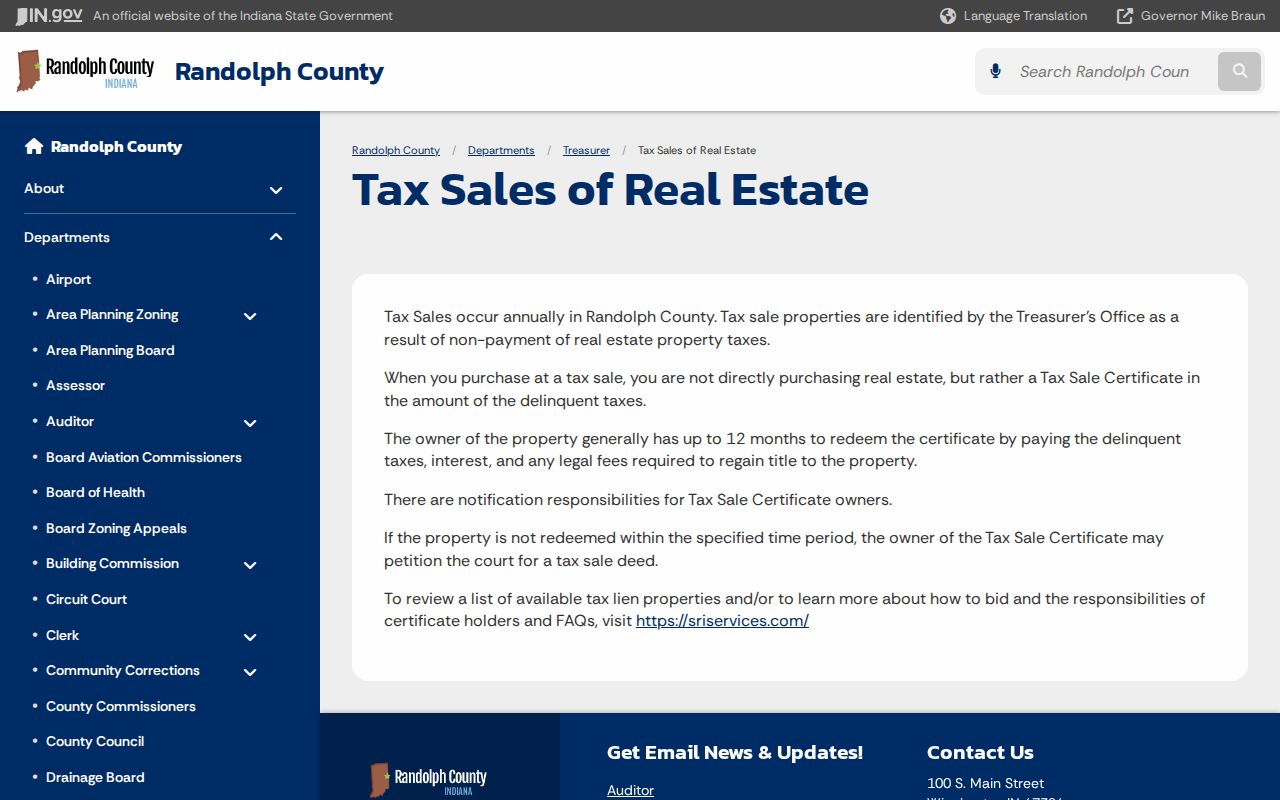
Check that guidance against the current sale notice, since property lists and sale dates change.
Randolph Reassessment Cycle
Indiana uses annual trending and is launching a statewide cyclical reassessment for 2026 through 2030. Starting July 1, 2026, roughly 25 percent of parcels get reassessed each year across the four-year cycle. That affects pay-2027 taxes and later. A value change can reflect new market data, a physical inspection, corrected property facts, or both at once.
Keep the notice date, appraisal date, land and improvement components, neighborhood code, and comparable sales in your file. Save the land and improvement breakdowns too. The Assessor provides county sales data. The office also keeps five years of sales disclosures. Compare like property classes. One nearby sale is not a benchmark.
Separate Randolph Tax Office Roles
Randolph County splits the tax workload across three offices. The Assessor estimates market value-in-use and keeps the detailed property card. The Auditor certifies assessed values, processes deeds and sales disclosures, runs the GIS, prepares township parcel plats, and administers deductions. The Treasurer bills and collects, posts payment history, applies delinquency rules, and manages the county side of tax sales. Getting the question to the right desk saves time.
A value error starts with the Assessor. A missing deduction or a deed still processing belongs with the Auditor. Bill, receipt, and penalty questions go to the Treasurer. Payment plans and delinquent balances land there too.
When a deed date and the bill owner differ, pull the recorded transfer and note the January 1 assessment date before asking the offices to reconcile the display. The Auditor's public tax list and LowTaxInfo are convenient entry points. Neither erases the source distinction. Save the parcel number, tax year, district, update label, and date viewed from each result, since one system may refresh before another. That provenance record is vital.
Document Randolph Appeal Evidence
A Randolph County assessment challenge works best when it pins down a specific problem. The problem can be factual, or it can be one of valuation. Compare the Assessor card against the parcel's actual acreage, land use, dwelling dimensions, and improvement condition as of the assessment date. Also weigh the property class, neighborhood code, and appraisal date. Mark the exact field you believe is wrong. Disagreeing with the bill in general never shows which assessment input deserves review.
Sales evidence needs the same discipline. Randolph keeps five years of sales disclosures in the Assessor's office. Sales material may surface through GIS. Pick transactions with similar class, use, location, land characteristics, and timing. State the source of each figure. Say whether the amount came from a recorded transfer. It might be from a sales disclosure, or an assessment screen. A distressed, family, estate, or otherwise atypical transfer may need context. Otherwise it cannot support a market-value-in-use comparison.
Keep one dated packet for everything. Form 11 belongs in it. So do the card, photographs, measurements, comparable records, correspondence, and proof of filing. Form 130 starts the local appeal. Unresolved matters move to the review board, the county assessment body for contested values. Check the current notice for the controlling deadline.
Appeal a Randolph Assessment
Start at the Randolph County Assessor's office. Identify the parcel, the assessment year, the value component at issue, and the facts you believe are wrong. Indiana's Form 130 opens the appeal path. When the matter is not resolved, the Property Tax Assessment Board of Appeals serves as the county-level review body.
Watch the filing window. Indiana guidance generally uses June 15 or 45 days after the Form 11 notice, whichever is later. Verify the deadline shown on the current notice before filing Form 130.
Useful evidence is concrete. Bring the property's current card. Corrected measurements or land classification help, as do photographs tied to the valuation date and comparable sales. A plain explanation of why the assessed facts or the market-value-in-use result misses helps too. Paying a bill and appealing an assessment are separate acts. Confirm payment obligations with the Treasurer while the dispute proceeds.
An APRA request can reach existing records. Sales disclosures, assessment records, deduction files, and tax-sale documents are all fair game. Request them by parcel and date range. It cannot force an office to build a custom valuation. Save the response, source URL, and date inspected. Randolph's tax systems refresh on different schedules.